Victoria Khiterer, „Bitter War of Memory: The Babyn Yar Massacre, Aftermath, and Commemoration“

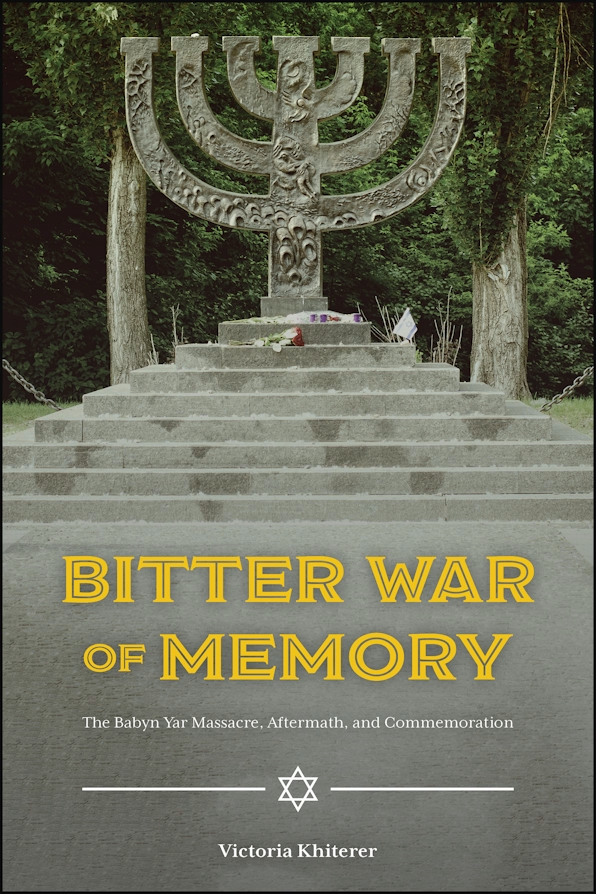
Bitter War of Memory: The Babyn Yar Massacre, Aftermath, and Commemoration discusses the Holocaust in Kyiv and the efforts to memorialize the Babyn Yar massacre. Babyn Yar is one of the largest Holocaust sites in the Soviet Union and modern Ukraine, where the Nazis and their collaborators killed virtually all the Jews who remained in the city during the occupation.
After the war, Soviet ideology suppressed commemoration of the Holocaust, instead conceptualizing the universal suffering of the Soviet people during the war. Police dispersed unauthorized commemoration meetings of Jewish activists at Babyn Yar. A monument “for one hundred thousand citizens of Kyiv and prisoners of the war” was erected in Babyn Yar in 1976, but the Holocaust was not mentioned in its inscription.
With the collapse of communism, state anti-Semitism ended. Holocaust commemoration became an important part of national memory politics in independent Ukraine. In the last few decades, over thirty monuments have been built at Babyn Yar, which are dedicated to the memory of Jews, Roma, members of the resistance movement, and other people executed there. However, heated debates continue about the commemoration of the Babyn Yar massacre.
Biography
Dr. Victoria Khiterer is a professor of history at Millersville University of Pennsylvania. Khiterer was born and grew up in Kyiv, Ukraine. She is the daughter and granddaughter of Holocaust survivors. Khiterer is a founding member of the Academic Council of the Babyn Yar Holocaust Memorial Center in Kyiv. She is author and editor of eight books and over a hundred articles on Ukrainian, Russian, and Eastern European Jewish history and the Holocaust. Her book, Jewish City or Inferno of Russian Israel? A History of the Jews in Kiev before February 1917, received the Choice Outstanding Academic Titles Award in 2017.
Table of Contents
List of Maps and Illustrations
Acknowledgments
Maps
Introduction
1. Kyivan Jews in the Interwar Period
2. The Babyn Yar Massacre: The Holocaust of Jews in Kyiv
3. Other Victims of the Nazi Regime in Kyiv
4. Jewish Life and Anti-Semitism in Postwar Kyiv
5. Aftermath of the Babyn Yar Massacre
6. Broken Silence over Babyn Yar
7. Babyn Yar Commemoration in Independent Ukraine
Conclusion
Notes
Bibliography
Index
About the Author
Reviews
“Victoria Khiterer has written an important addition to the growing scholarship on Babyn Yar, the largest Holocaust site in the Soviet Union. On the backdrop of the history of Kyivan Jewry during the Soviet and post-Soviet years, she offers a thoroughly researched and insightful exploration of Babyn Yar’s contested memory. Drawing on new archival sources, memoirs, and interviews, she chronicles the memory wars that erupted over this site of massacres from Stalin’s Black Years, through Khrushchev’s Thaw, into the Perestroika and the collapse of the Soviet Union, until the present day with Russia’s war against Ukraine. This monograph raises key questions in the study of the politics of memory in the aftermath of genocide.” – Elissa Bemporad, Jerry and William Ungar Chair in East European Jewish History and the Holocaust, professor of history, Queens College and the CUNY Graduate Center; and author of Legacy of Blood: Jews, Pogroms, and Ritual Murder in the Lands of the Soviets
“Babyn Yar was one of the largest killing grounds of Jews in the Soviet Union during the Second World War. It has been estimated that the Nazis, with the support of their local collaborators, murdered from 70,000 to 80,000 Jews there, as well as many prisoners of war, Roma, members of the Soviet underground movement, and Ukrainian nationalists. In all, about 100,000 people were killed in the ravine. Victoria Khiterer examines in a clear and dispassionate way why it took so long for a monument to be built on the site and how it can be made a center for Holocaust research and commemoration in Ukraine. This major path-breaking monograph will transform our understanding both of the way the Holocaust was carried out in Ukraine and how it has been remembered in the nearly eighty years since the end of the war.” – Antony Polonsky, emeritus professor of Holocaust studies, Brandeis University, and chief historian, Global Educational Outreach Program, POLIN Museum of the History of Polish Jews in Warsaw
Published in June 2025
ISBN: 9781626711136
322 pages
Purdue University Press
Trebate biti prijavljeni kako bi objavili komentar.