Everyday Postsocialism in Eastern Europe: History Doesn’t Travel in One Direction
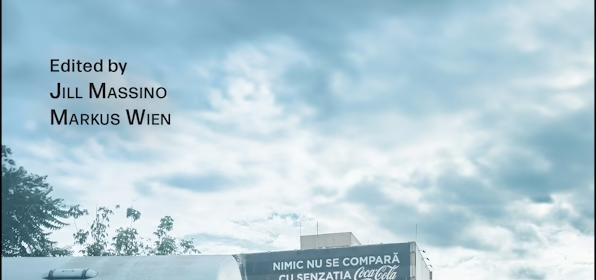
Edited by Jill Massino and Markus Wien
The collapse of state socialism ushered in dramatic political and economic change, producing new freedoms and opportunities, but also new challenges and disappointments. Focusing on laborers, professionals, youth, women, sexual minorities, foreign students, and emigrants, Everyday Postsocialism in Eastern Europe explores these multifaceted changes and people’s varied experiences of them. The featured narratives complicate hegemonic representations of transformation, revealing ruptures and continuities, progress and reversals. Highlighting the multi-directionality of change over the last thirty years, the book reappraises 1989 as an epochal event for all.
Contents
Foreword: Mapping Heres and Theres, by Cristofer Scarboro
Acknowledgments
Introduction: Everyday Postsocialism in Eastern Europe: Continuities, Ruptures, and Alternative Temporalities, by Jill Massino and Markus Wien
PART I: SOCIOECONOMIC TRANSFORMATIONS
1. “People Knew They Wouldn’t Have to Scrape Dry Chocolate if They Called Me In”: Industry, Subjectivity, and the Long Transformation, by Joanna Wawrzyniak
2. How Foreigners Destroyed our Factory: Repressed Memories of a Czech Flagship Sugar Plant, by Ondřej Klípa
3. From Risk to Risky: Hungary’s Second Economy and Its Transition to the Market after 1989, by Annina Gagyiova
PART II: THE POLITICS OF EXCLUSION
4. “There’s a Lot of Talk About Tolerance, but That’s Just Words”: Being Gay in Postsocialist Poland, by Agnieszka Kościańska
5. Reinventing Postsocialism as Heteronationalism: (Dis)continuities and Frictive Biopolitics in Orbán’s Hungary, by Hadley Z. Renkin
6. Eradicating Socialist Internationalism: The Expulsion of Foreign Students in Postsocialist Bulgaria, by Raia Apostolova
PART III: SOMETHING OLD, SOMETHING NEW
7. The Specter of Sex: Continuities and Changes in Sex Education in Postsocialist Romania, by Beatrice Scutaru and Luciana Jinga
8. No Country for (Poor) Women: Reproductive Rights, Conservatism, and Neoliberalism in Postsocialist Romania, by Corina Doboș
PART IV: ORIGIN STORIES
9. The “Turncoat” as a Social Form: Tracing Everyday Moral Grammars of Justice in Post-1989 East Germany and Czechia, by Till Hilmar
10. From Steppe to State: Alternative Histories, Amateur Knowledge, and the Search for Origin in Post-1989 Bulgaria, by Victor Petrov
11. “I’m An Outsider, I’m An Insider, And Oh, How Happy I Am”: Narratives of Former Communist Party Members in Hungary, by Sándor Horváth
PART V: HOME IS WHERE THE HEART IS
12. Children of the Wende: Everyday Experiences of the Postsocialist Transformation in (East) Germany, by Friederike Kind-Kovács
13. Out of Sight but Not Out of Mind: The Romanian Diaspora and Politics at Home, by Sergiu Gherghina and Raluca Farcas
Contributors
Index
Authors
Jill Massino is an associate professor of history at the University of North Carolina at Charlotte. She is the author of Ambiguous Transitions: Gender, the State, and Everyday Life in Socialist and Postsocialist Romania and coeditor of Gender Politics and Everyday Life in State Socialist Eastern and Central Europe.
Markus Wien is professor of European history at the American University in Bulgaria. His publications include Market and Modernization: German-Bulgarian Economic Relations 1918–1944 and Their Conceptual Foundations and numerous articles and book chapters on minorities in Bulgaria, Bulgarian politics, and German development projects in interwar Bulgaria.
Praise
“This rich examination of ‘real existing postsocialism’ powerfully argues against both triumphal narratives of transition and laments of its failure. Its analysis of how communities navigate uneven temporalities and conflicting historical trajectories also offers crucial context to illuminate the challenges produced by neoliberalism, as well as the recent rise of populism and authoritarianism in the region.” —Maya Nadkarni, Associate Professor of Anthropology, Swarthmore College
“The collapse of communism in Eastern Europe in 1989 was far from being ‘the end of history.’ On the contrary, the authors in this collection show that history gained new momentum, shaping both events and people alike. Each chapter in this compelling collection demonstrates how diverse individuals, including blue-collar workers, professionals, former communist party members, foreign students, and sexual minorities, navigated the significant shifts brought about by the system’s disintegration. Marking one of the first attempts to historicize the year 1989, the chapters in this volume vividly capture the challenges and complexities of ordinary lives both during and after communism.” —Malgorzata Fidelis, Professor of History, University of Illinois Chicago
Published: 2024-09-15